
“Jail is the first place where I read a book.”
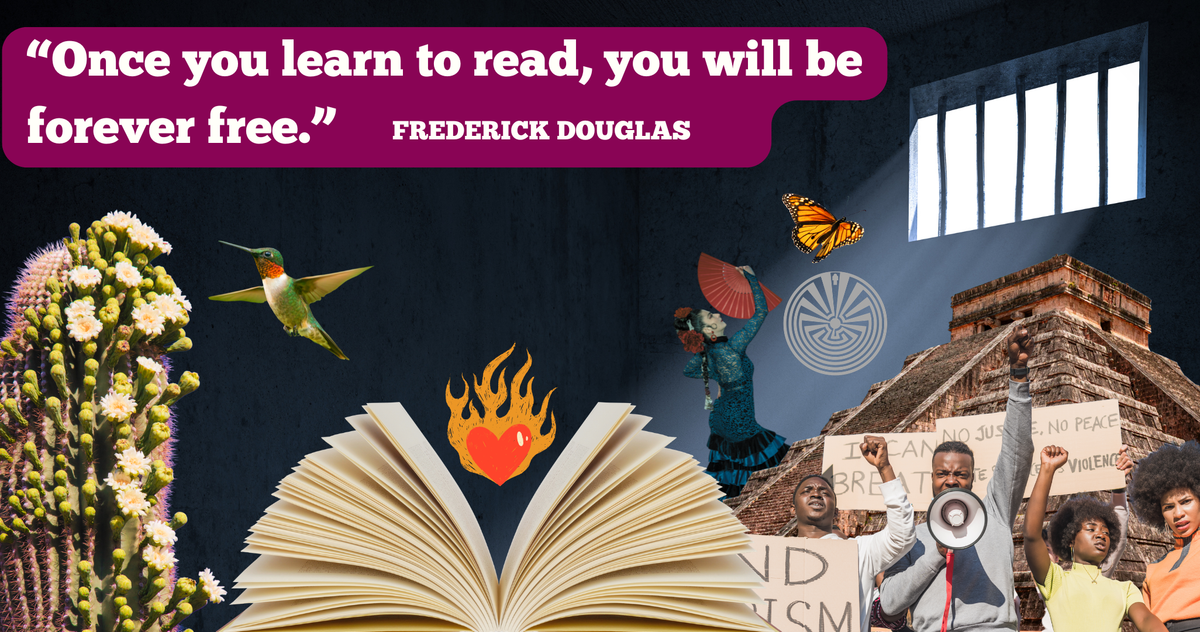
Last week, I returned to my job at a youth jail with fresh eyes and a broken heart. After a 3 week break, I felt totally re-sensitized to the nightmare: the US locks up more people per capita than almost any nation, and many of those people are children.
It’s not called a jail, of course. It’s call a Juvenile Detention Center. Sounds like a euphemism, huh? Reasonable. Abstract. Procedural. But is it a euphemism? “Detention” means “keeping back or withholding.” Sounds like the state is saying the quiet part out loud.
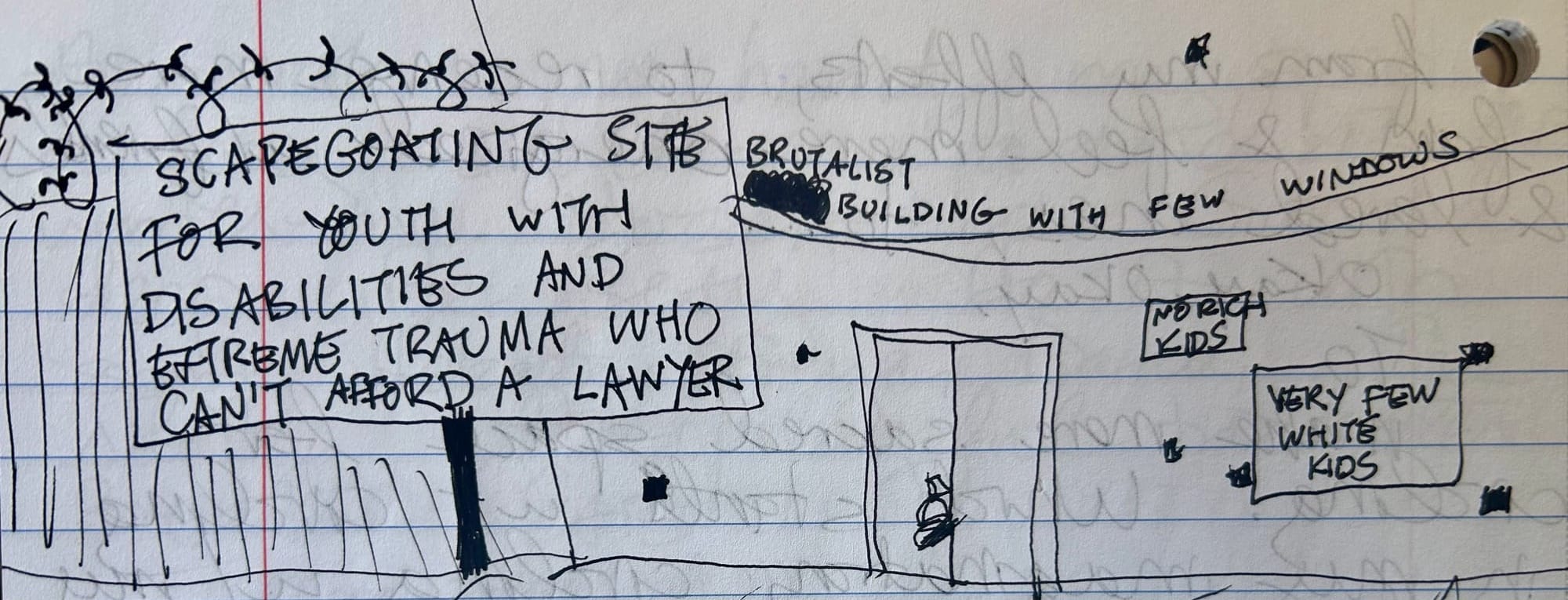
Most of my incarcerated students are 13 to 18, but I’ve had kids as young as 11. All are survivors of complex trauma. Many are 2nd or 3rd generation incarcerated; they grew up visiting (or not visiting) their own mom or dad in a dingy little gray room, their every move watched over by guards and surveillance cameras. Many of my students were first separated from their families by "Child Protective Services," aka Jane Crow. None of their families have money for a private lawyer. Almost none of them are white.
“I feel like this is a bad dream.” Several of my students have told me that. And yet, they make the most of it. They make dear friends, and connect with old pals who they knew on the outs. They draw elaborate pictures of sick sneakers and beautiful girls and sexy bunnies and sweet cars and badass tattoos. They write letters to Mom, or Nana, or their sweetheart, and send them snail mail. They joke and poke fun at cool JDOs (juvenile detention officers), and play pranks on the uptight ones, the stony-faced officers who look like they'd outlaw joy, if they could.
When they’re suspended from school because they mouthed off, or punched someone, or threw a chair in frustration, they’re locked in their room, where they can have no pens, pencils, or even crayons. So they sleep all day. Or they yell and stim and sing to make their podmates laugh - or groan. They do push-ups and sit-ups. They use their fingernails to carve things from soap. They make pets of the crickets who’ve invaded the jail, stroking and feeding the little insects who serenade them at all hours with sounds of the night.
And they pursue pretty much the only hobby that’s available to them inside their room: they read. And read. And read. A few students have told me, “In here is the first time I’ve ever read a whole book.” That could be a reflection on their turbulent lives. But also, many schools don't assign books anymore.
Oh, the irony! Books are “safe.” Books are pretty much the only object allowed in their rooms. You can’t use a book to make a shank, or to hurt yourself. But reading is dangerous - as in, reading is powerful.
I know reading is powerful because the US has the world's most expensive military and the world's most expensive prison system, and yet, 65% of 4th graders can't read at grade level. We don't get statistics like that by accident. We get them by design. There must be some reason why the people who profit from the bombs and guns and cages and cuffs and ankle monitors don't want us and our kids to read... but I'll spare you the soap box, and let you think about it yourself.
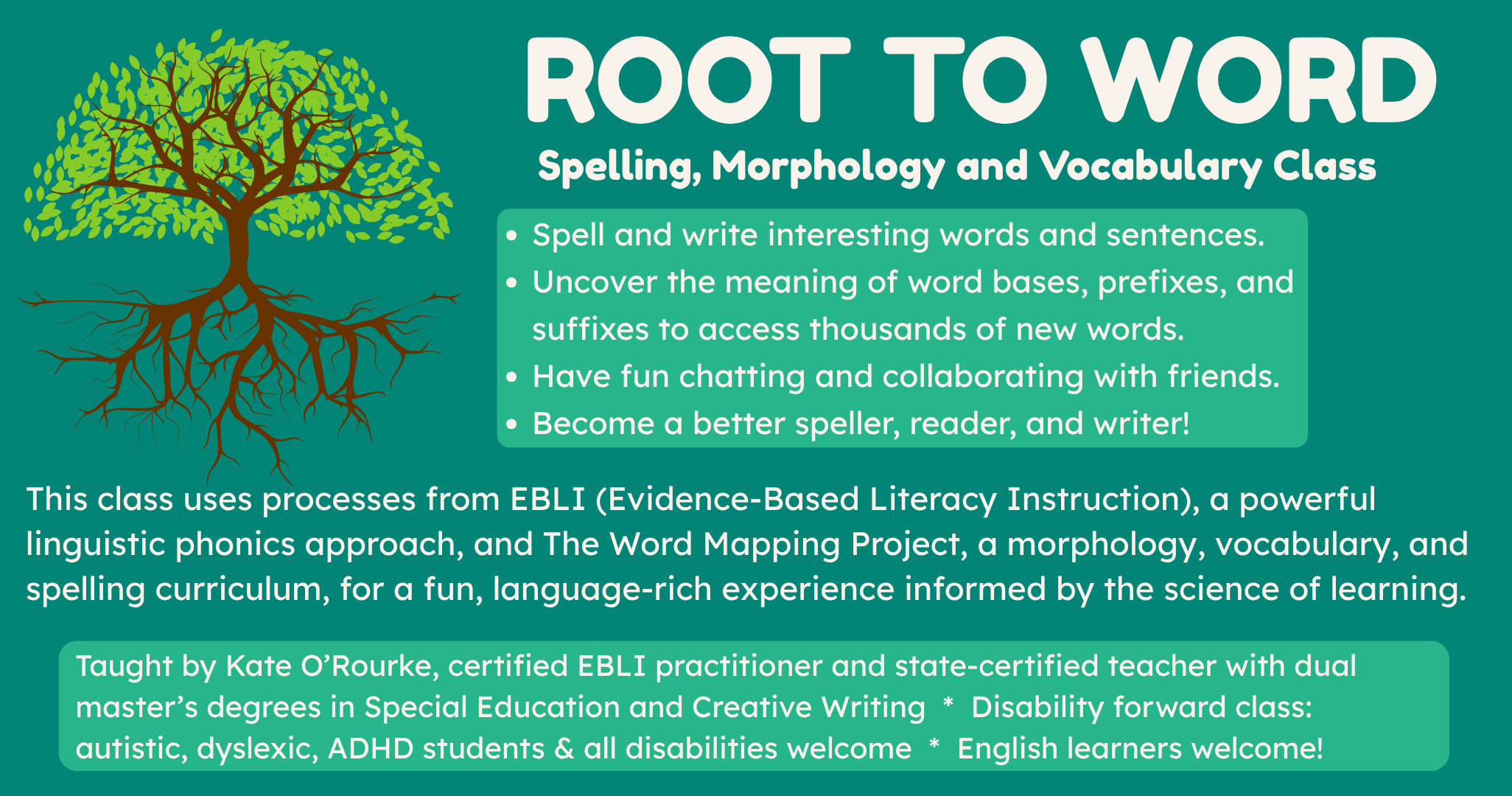
This summer, I got certified in EBLI (Evidence-Based Literacy Instruction), a linguistic phonics method that boosts reading fluency, writing, and spelling for people of all ages - not by teaching a bunch of mind-numbing rules, but by activating student voice, pattern thinking, and teaching learners to teach themselves. It’s so effective, my heart hurts that I didn’t use it in the past. I wish I could time travel back and give all my students EBLI! It’s accessible for people with disabilities, yet challenging and rigorous for all. I also trained in Releasing Writers / ThinkSRSD, a science of writing method that leverages learner self-talk, self-regulation, and self-assessment for stronger motivation and more powerful prose. I’m excited to share these brilliant yet simple methods with more students!
Also, my inner word nerd is SO HAPPY to teach a virtual morphology and spelling class this fall, in collaboration with Peak Reading Solutions. The class is for grades 5-7 (flexible age range) and meets at 4pm Pacific Mondays and Wednesdays, for 45 minutes, starting September 28. Another teacher will run a class for grades 4-6 at 7am Pacific on Tuesdays and Wednesdays. If you’re interested in either class, fill out this form!
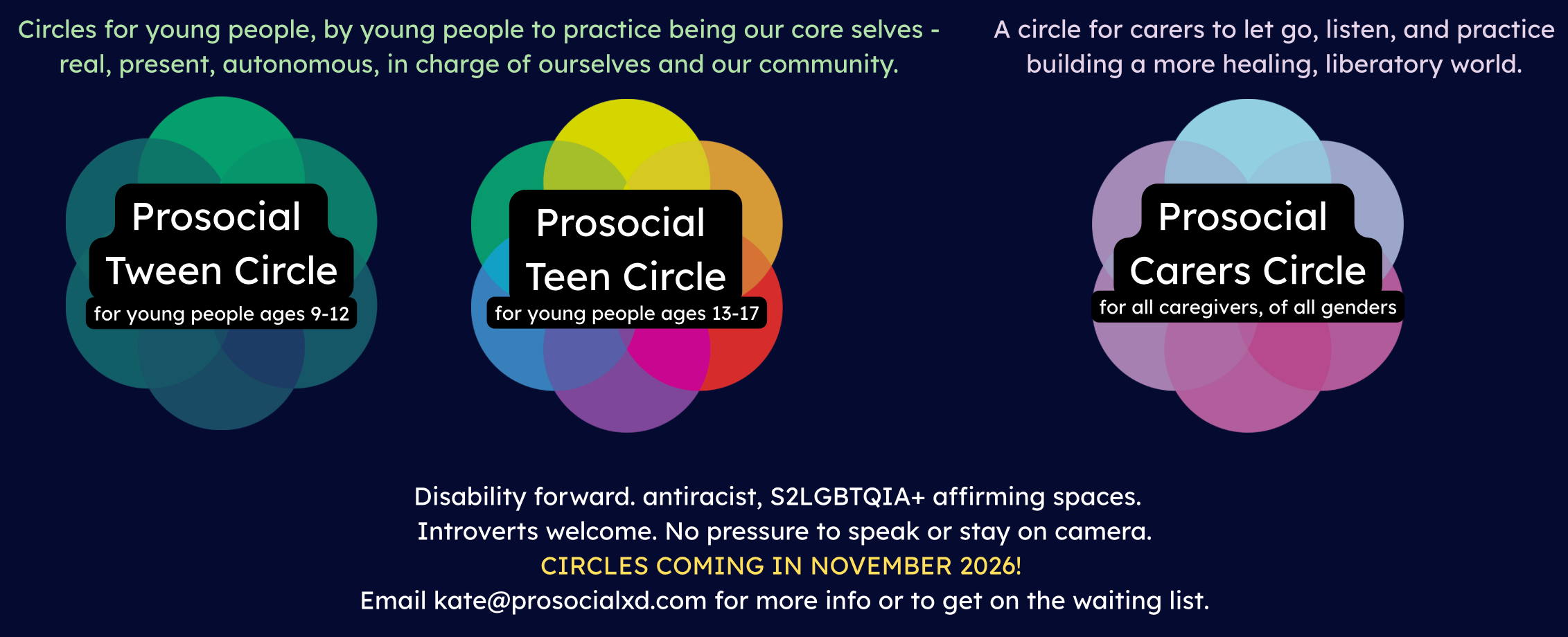
Finally, I'm excited to return to my circlekeeping roots and start facilitating virtual circles for tweens, teens, and caregivers! I'm planning to start in November 2026 and will announce days and times soon - email me with questions and requests! Caregiver circles are monthly drop-in events; youth circles are weekly spaces where participants can take on leadership roles and help facilitate the circle when they're ready, while I act as adult ally / guide on the side. These are LGBTQIA+ affirming, antiracist, disability forward spaces that promote youth autonomy and a chance to practice being our core selves - no matter how weird we are. Camera on or off; introverts welcome.
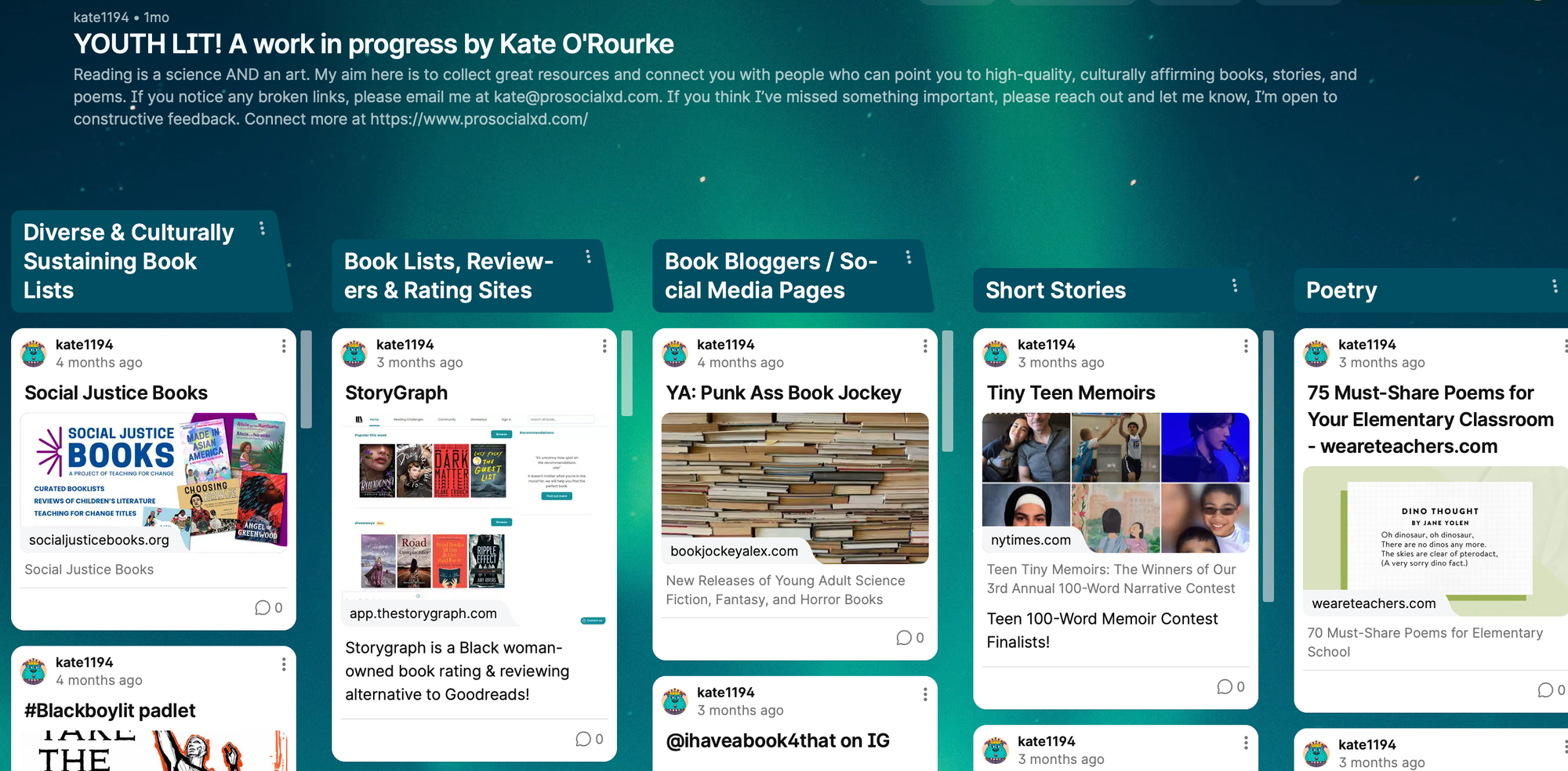
A bit of lovely news about the jail where I work: they have a very decent library. Every pod has carts stacked with books of all reading levels, many written by women and people of the global majority. The kids are always giving me book recs for realistic fiction and memoir, and I've included a lot of their favorites in my YOUTH LIT padlet. It’s my goal to have authentic, culturally affirming literature for everyone on there, so if I’m missing something you love - email me at kate@prosocialxd.com and let me know!
Are you really still here? Wow! Thank you for reading. I appreciate you. I'll leave you with the words of Mariame Kaba: "Hope is a discipline." Whenever I'm tempted to despair, I think of our young people who did not ask for this mess and did not create it. I feel lucky to be able to spend some time with them every day, showing up and doing my part to make the world just a little bit less crappy. I wish similar joys upon you, too.
"No one educates anyone else, nor do we educate ourselves; we educate one another in communion, in the context of living in this world.” - Paulo Freire
Kate O’Rourke, Prosocial Learning, LLC

